

In the world of industrial automation and energy supply, communication is becoming increasingly complex and more important than ever. Systems must not only be controlled locally but also monitored and managed remotely across multiple sites. This is where remote control technology comes into play.
But what does that actually mean? And how does PLCnext Technology help to meet these challenges?
What Is Remote Control Technology and What Is an RTU?
Remote control technology refers to the ability to monitor and control geographically dispersed systems such as distribution substations, high-voltage substations or renewable energy plants from a distance. This is especially critical for energy providers, municipal utilities or operators of critical infrastructure.
A key component is the RTU (Remote Terminal Unit). It acts as the link between the local system and the central control center. The RTU collects data, transmits it and receives control commands via standardized communication protocols.
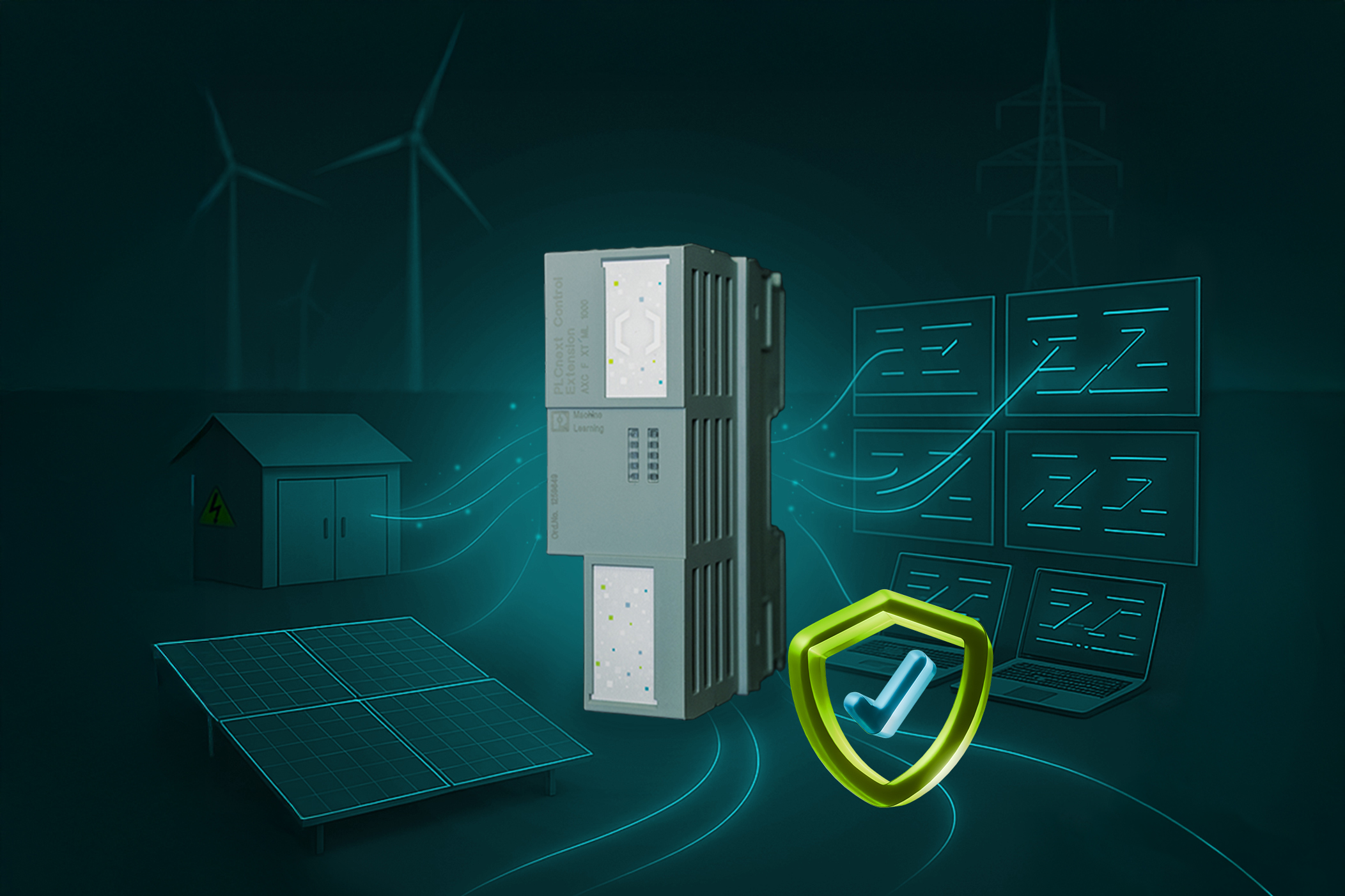
Traditionally, RTUs were standalone devices. With PLCnext Technology, conventional PLC controllers can be extended into scalable RTUs using industry-specific apps, certified and ready for global deployment.
Why Certifications Matter
In critical infrastructures like energy supply, strict requirements for security and reliability apply. Systems must comply with specific standards, verified by independent certification bodies.
Our PLCnext Control was recently certified by two internationally recognized organizations:
- DNV (Netherlands): Certified according to IEC 60870-5-104, IEC 61850 Ed. 2.1 and IEC 62351-3
- CPRI (India): Certification according to IEC 60870-5-104, IEC 62351-3 and IEC 62351-5
These standards define secure communication in energy management systems. They ensure that data is encrypted, authenticated and protected against manipulation.
What’s Behind These Standards?
- IEC 60870-5-104: A widely used remote control protocol enabling communication between RTUs and control centers over IP networks. Common in Europe and Asia.
- IEC 61850 Ed. 2.1: An international standard for communication within electrical substations, supporting interoperability and advanced data modeling.
- IEC 62351-3: Adds security mechanisms such as TLS encryption and mutual authentication.
- IEC 62351-5: Defines access control at the application level, for example who can view or modify data.
Sure, remembering all these standards is not that easy, but these standards are not just technical specifications, they form the foundation of trust. They prove that the technology is secure, tested and ready for use in sensitive environments.
RTU Functionality via App Directly from the PLCnext Store
A major advantage for developers and system integrators: Certified protocols are available as apps in the PLCnext Store. This allows you to extend your controller into an RTU without additional hardware.
Here are some of the key protocols you can install directly:
These protocols cover the diverse regional requirements of the energy sector, all by simply installing apps from the PLCnext Store on your controller. The PLC handles local control functions while the RTU functionality ensures direct communication with the grid control system and subordinate devices. This makes grid connection not only compliant but also future-proof if operators update their technical connection rules or demand additional features. The result is a modular, scalable solution that adapts flexibly to new requirements.
One System, Many Possibilities
With PLCnext Technology, you combine the benefits of classic PLC control with the demands of modern remote control technology:
- Local control such as switchgear operation, transformer control or feed in management
- Remote communication with grid operators or control centers
- Certified security for critical infrastructures
- Open architecture for future extensions
This is particularly relevant for operators of renewable energy plants such as wind and solar farms who need to connect their systems to the grid in a compliant and future-proof way.
Security, Flexibility and Future-Readiness
Remote control technology is not a niche topic, it is essential for the energy transition and the secure operation of interconnected systems. And with PLCnext Technology, you get a platform that is:
- Certified for international security standards ✅
- Flexibly expandable via apps ✅
- Scalable for small and large applications ✅
- Future-proof thanks to open interfaces ✅
Whether you are just starting out or managing complex systems, PLCnext Technology gives you the tools to work securely, efficiently and in a connected way.

