

Insights from the Auf Draht podcast with Phoenix Contact and MicroDoc.
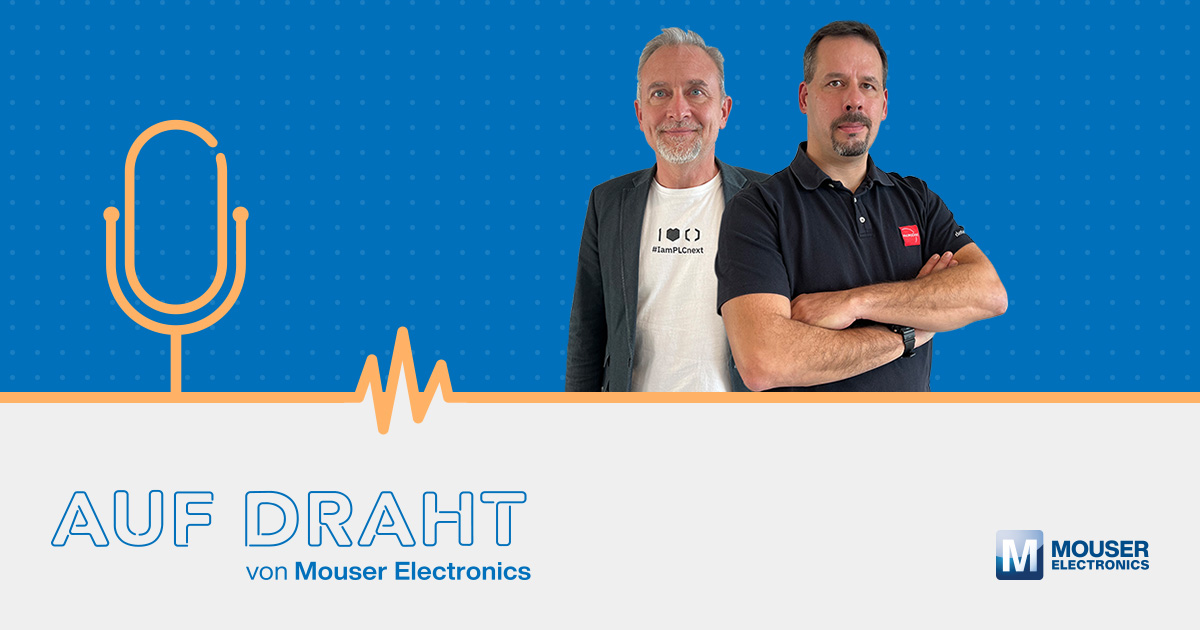
Industrial automation is changing rapidly. As factories become more connected, industrial companies face the challenge of bringing operational technology (OT) together with modern IT systems in a secure and efficient way. In a recent episode of the German podcast Auf Draht, hosted by Stuart Cording, two experts provided valuable insights. The guests were Michael Gulsch, Senior Specialist Automation Controls at Phoenix Contact, and Dr. Christian Kuka, Managing Director and CTO at MicroDoc, one of our partners in the PLCnext Store.
This article summarises their conversation and shows how PLCnext Technology supports open, scalable and future ready automation. It also explains how MicroDoc’s applications make cloud connectivity easier for everyone working with industrial systems.
From classic PLCs to open automation platforms
PLCs have been the trusted foundation of industrial automation for decades. Their predictable behaviour and high reliability allow engineers to control machines, production lines and entire plants. However, modern production environments require more than sequential logic or closed control architectures. They demand data availability, connectivity and agile development practices.
As Michael Gulsch explains:
“PLCnext Technology is not restrictive. It does not force you into one direction and it is open enough to let every developer work in the programming paradigm where they can unfold their creativity.”
PLCnext Technology introduces a new automation platform based on Linux with a modular and open architecture. It supports IEC 61131 programming, high level languages such as C plus plus and Python, as well as model based design with MATLAB Simulink. Developers can choose how they want to work and teams can collaborate across disciplines.
This openness is increasingly important for connecting industrial controllers with cloud services, analytics platforms and modern software environments. It also makes it easier for partners like MicroDoc to contribute new capabilities directly to PLCnext Technology users.
Why IT and OT convergence is becoming essential
Production environments are moving away from isolated control systems and towards connected ecosystems. This creates new possibilities for transparency, monitoring and optimisation. It also introduces new risks related to cybersecurity, data ownership and system complexity.
Cloud platforms such as Microsoft Azure and Amazon Web Services offer scalable infrastructure and advanced data services. They allow companies to analyse machine data, create dashboards or build predictive maintenance solutions. However, connecting a real time industrial controller to cloud services is not a simple task.
As Dr. Christian Kuka describes:
“On the cloud side everything changes constantly. There are thousands of dependencies that must stay up to date. On a PLC software usually stays static. These two worlds must be integrated carefully.”
This difference in development culture is a challenge for many industrial teams. PLC software is typically validated once and then kept stable for years. Cloud applications are updated continuously and require permanent maintenance, certificate updates and security monitoring.
PLCnext Technology helps bridge this gap through its modular architecture and its open interfaces. Developers can build cloud ready components in containers, test them locally and deploy them via the PLCnext Store.
The PLCnext Store as a driver of innovation
One of the central elements of the PLCnext Technology Ecosystem is the PLCnext Store. It allows partners and developers to offer ready to use apps that extend PLC functionality. Just as on a smartphone, users can download, install and update apps directly on the controller.
Michael emphasises:
“We did not only build a new runtime for automation. We created a complete ecosystem. The PLCnext Store is the place where third party experts can provide their knowledge and offer their functionalities.”
MicroDoc apps that simplify cloud connectivity
MicroDoc offers applications that help users visualise OPC UA data and connect PLCnext Control to cloud services.
OPC UA Browser
The OPC UA Browser provides a web based view of OPC UA data directly on the PLCnext Control. Developers can navigate through the available nodes and inspect data values. The app uses modern web technologies and feels familiar to software developers who work with cloud environments.
Cloud connectivity apps for Azure and AWS
MicroDoc’s second app family focuses on sending data from PLCnext Control to cloud platforms. The apps support Azure Event Hub and AWS Kinesis. They allow users to select OPC UA values and publish them to cloud services where they can be processed further.
Examples of use cases include predictive maintenance, combined analysis of multiple PLCs or integration with dashboards and analytics tools.
As Christian explains:
“We did not only build a new runtime for automation. We created a complete ecosystem. The PLCnext Store is the place where third party experts can provide their knowledge and offer their functionalities.”
This approach demonstrates how modern software development practices can enter the world of industrial automation.
Rust, Python and the future of industrial software
Rust is gaining momentum in industrial applications because it offers strong memory safety and a modern developer experience. Christian highlights the advantages:
“Rust gives you control over memory with safety guarantees. It also comes with a very good ecosystem. All of this can now run on PLCnext Control because the architecture is open.”
This is an important development for the automation industry. It allows new kinds of applications such as analytics functions, AI models or scalable architectures to run at the edge, right on the industrial controller.
The PLCnext Community as a place to learn and grow
The PLCnext Community plays a key role in helping developers get started quickly. It provides tutorials, guides, forum discussions, GitHub links and examples for both IEC 61131 and high level languages.
Michael notes:
“It is great to see how questions solve themselves. One user asks and another one jumps in. The community truly lives.”
This community driven approach supports openness, collaboration and knowledge sharing. It also helps new users experience how flexible PLCnext Technology really is.
Conclusion: Open automation is becoming reality
The conversation in the Auf Draht podcast makes one point very clear. Industrial companies can only benefit from the possibilities of Industry 4.0 if they can combine OT and IT in a seamless and secure way.
PLCnext Technology provides the foundation for this combination. MicroDoc complements it with cloud ready applications and deep IT expertise. The community brings people together and accelerates learning.
The result is a modern and open automation ecosystem that supports innovation today and in the future.
Explore MicroDoc apps in the PLCnext Store
Discover MicroDoc’s OPC UA Browser and cloud connectivity apps for Azure and AWS: PLCnext Store | The open software store for automation
Listen to the original podcast episode in German
Here is the full Auf Draht episode featuring Michael Gulsch and Dr. Christian Kuka: AUF DRAHT Podcast von Mouser Electronics

