

When a sensor fails in a pulp mill, the impact can reach far beyond a single measurement point. In continuous industrial processes, missing or unreliable process values can affect stability, efficiency, and operational confidence. At Celulosa ARAUCO in Chile, PLCnext Technology was used to bring Machine Learning into the OT environment: securely, pragmatically, and without replacing the existing Distributed Control System.
The result: a virtual sensor architecture that estimates critical process values in real time and feeds them back into the plant control system. For ARAUCO, this creates a more resilient foundation for pulp production and demonstrates how open automation can turn existing process data into operational value.
The challenge: Reliable information in a demanding process environment
Pulp production depends on a continuous flow of trustworthy process data. Sensors provide the values operators, and control systems need to keep production stable. But in complex chemical processes, physical instrumentation can fail, drift, or temporarily deliver values that are no longer reliable.
For ARAUCO, the question was not simply how to collect more data. The goal was to maintain critical process information when a physical sensor becomes unavailable without disrupting the existing automation architecture and while respecting cybersecurity requirements in the OT environment.
From sensor dependency to virtual sensing
The solution used historical and live process data to build a Machine Learning-based virtual sensor, also known as a soft sensor. Instead of relying on one physical measurement alone, the model identifies patterns in related process variables and estimates the missing critical value in real time.
Compared with a previously evaluated linear model, the Machine Learning approach delivered significantly better accuracy and reached the performance required for this industrial use case.
Why PLCnext Technology matters in this use case
PLCnext Technology played the role of an operational bridge between the Machine Learning model and the existing Distributed Control System. Its openness made it possible to connect industrial automation with data science methods and integrate the Machine Learning model into the plant’s control environment.
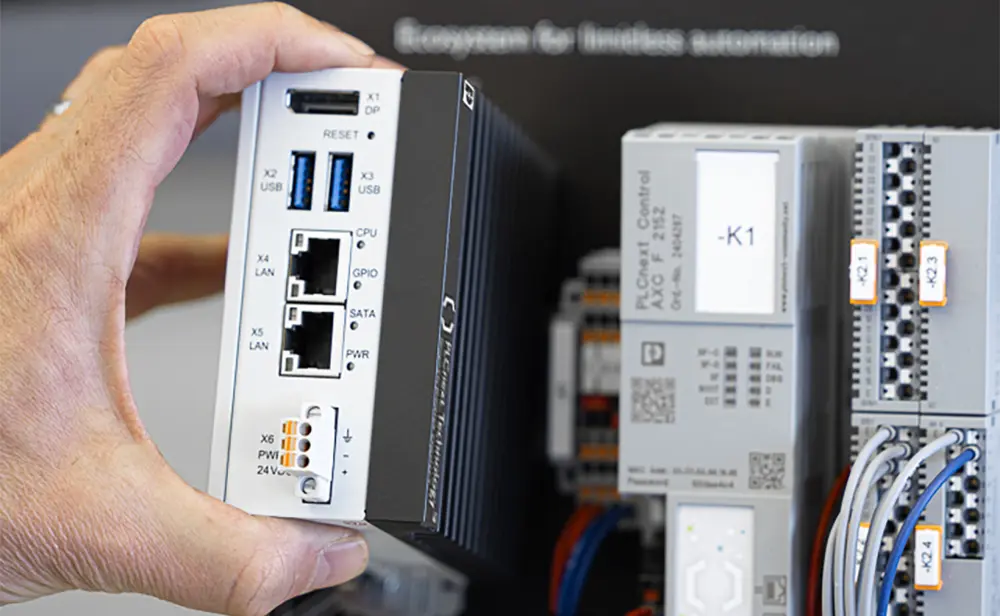
In the ARAUCO project, a Phoenix Contact EPC1522 Industrial PC was used inside the OT environment to run the Machine Learning model and connect it with the plant automation system. The architecture enabled AI-generated values to be sent back to the DCS via industrial communication, including Modbus-based integration, so operators and control systems could continue working with the estimated process value as part of normal operations.
For the project team, this openness was essential. PLCnext Technology made it possible to combine automation expertise with data science methods, use high-level programming approaches such as Python, and integrate Machine Learning functionality without major modifications to the existing DCS infrastructure.
Architecture at a glance
- Operational data was collected from the process historian and the existing automation infrastructure.
- Relevant process variables with similar behavior to the critical sensor value were identified.
- A Machine Learning model was developed to estimate the missing measurement in real time.
- The model was deployed on a Phoenix Contact EPC1522 in the OT environment.
- Predicted values were communicated back to the DCS for operational use.
Secure AI deployment in OT
Introducing Machine Learning into industrial control environments is rarely just a technical exercise. Cybersecurity, network separation, communication paths, and operational robustness are part of the design from the beginning.
In this case, the EPC1522 acted as a dedicated platform for the Machine Learning application. It allowed the AI function to be implemented close to the process while maintaining the separation and communication rules required in the OT network. This supported secure integration into the OT environment and practical use in day-to-day plant operation.
Operational value: Continuity when instrumentation fails
The most immediate benefit is the continuous availability of critical process information. If a physical sensor fails or becomes unreliable, the virtual sensor can help keep the relevant process value available for monitoring and control. This reduces dependency on a single measurement point and supports more stable operations.
For a large continuous production environment such as a modern pulp mill, avoiding unplanned interruptions can have significant business relevance. The Machine Learning-based virtual sensor can help maintain production continuity during sensor failures and reduce operational risk.
A foundation for future advanced process control
This case shows how PLCnext Technology can support a step-by-step path toward Industrial AI. The virtual sensor is not an isolated experiment; it establishes an architecture that can be extended toward advanced process control concepts such as Model Predictive Control, intelligent PID optimization, fuzzy control, and expert systems.
Because PLCnext Technology is open by design, it can bring together existing automation assets, industrial communication, high-level programming, and Machine Learning frameworks in one pragmatic environment. That combination is especially relevant for plants that want to modernize without tearing out proven control infrastructure.
What the PLCnext Community can take away
This project illustrates a practical pattern for Industrial AI in brownfield environments: start with a concrete operational problem, use available process data, deploy the model securely at the edge, and integrate the result back into existing control workflows.
For developers, automation engineers, and data scientists working with PLCnext Technology, the message is clear: Industrial AI becomes much more valuable when it can be connected to real control environments. PLCnext Technology provides the open automation foundation to make that connection possible.
Key benefits at a glance
- Continuous availability of critical process information during sensor failures
- Improved process reliability and reduced operational risk
- More accurate prediction compared with the previously evaluated linear model
- Real-time integration of AI-generated values into an existing DCS environment
- Secure deployment of Machine Learning functionality within OT requirements
- Scalable foundation for future advanced process control applications
Conclusion: Open automation turns data into resilience
ARAUCO’s virtual sensor use case is a strong example of how Industrial AI can move from concept to practical plant operation. By using PLCnext Technology as the bridge between Machine Learning and the DCS, critical information remains available when physical instrumentation cannot provide it.
For the PLCnext Community, the case highlights what open industrial automation is designed to enable: modern software approaches, secure OT integration, and real operational value without forcing manufacturers to start from scratch.

