


For decades, industrial automation has been shaped by programmable logic controllers (PLCs). Their robustness, deterministic operation, and clear structure have made them the backbone of countless applications. However, as demands for flexibility, scalability, and IT integration increase, conventional PLC architectures are increasingly reaching their limits.
Modern production environments require faster adaptability, scalable CPU and RAM resources for application projects, fewer hardware resources in the IT landscape, freedom in the choice of programming languages and tools, and the integration of data-driven processes. At the same time, the need to connect control systems more closely with IT infrastructures is growing. Traditionally hardware-bound PLCs can meet these requirements only to a limited extent. The result is a paradigm shift in automation.
Virtualization as the logical next step
Virtualization has long been established in IT and has proven to be a key technology for more efficient resource utilization and flexible system architectures. This approach is now also entering the field of automation technology.
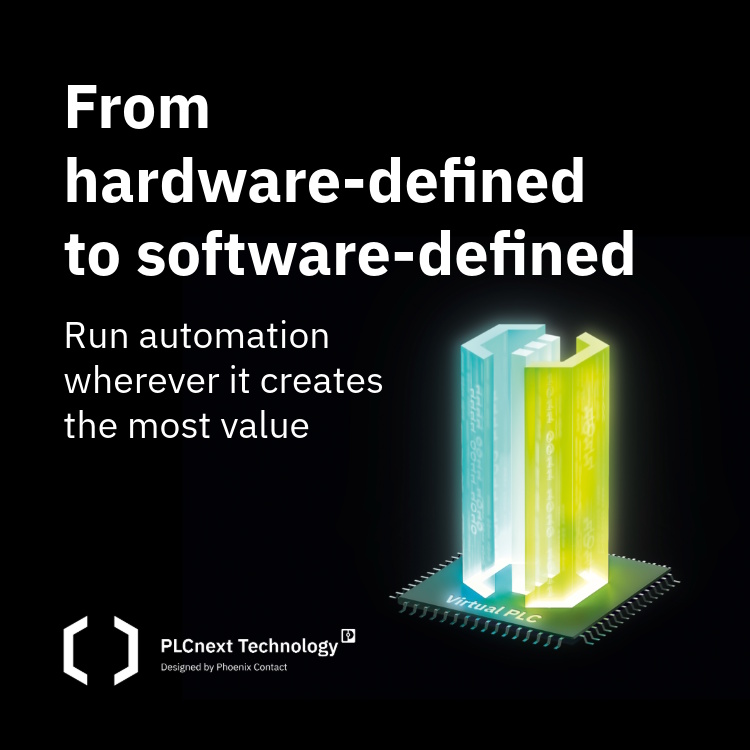
Instead of tying control logic to specific hardware, it is transferred to a virtual environment. Virtual PLCnext Control is one example of this development: The controller runs independently of physical hardware on industrial servers, industrial PCs, or on edge devices.
This step offers clear advantages:
- Scalability: Resources such as CPU and RAM can be adjusted dynamically
- Flexibility: Control instances can be deployed or migrated quickly
(container technology and deployment) - Centralization: Multiple controllers can be consolidated on one platform (multiple instances)
- Efficiency: Better utilization of existing hardware, lower hardware costs, and reduced maintenance effort associated with IT security requirements
Virtualization is more than a technical advancement. It marks the beginning of an entirely new way of thinking and makes IT/OT convergence a reality.
Virtual PLCnext Control as a new architectural model
The virtual PLC (vPLC) is not simply a virtualized PLC; it represents a new architectural model for industrial automation.
The key difference lies not only in virtualization, but in making the controller itself part of a comprehensive software architecture. Control logic thus becomes a modular, integrable component of an overall digital system.
This enables:
- Close integration with IT services
- Use of modern software architectures
- Extensibility beyond conventional automation boundaries
- Data exchange between systems within a software architecture
The controller therefore evolves from an isolated system into an open, software-centric platform.
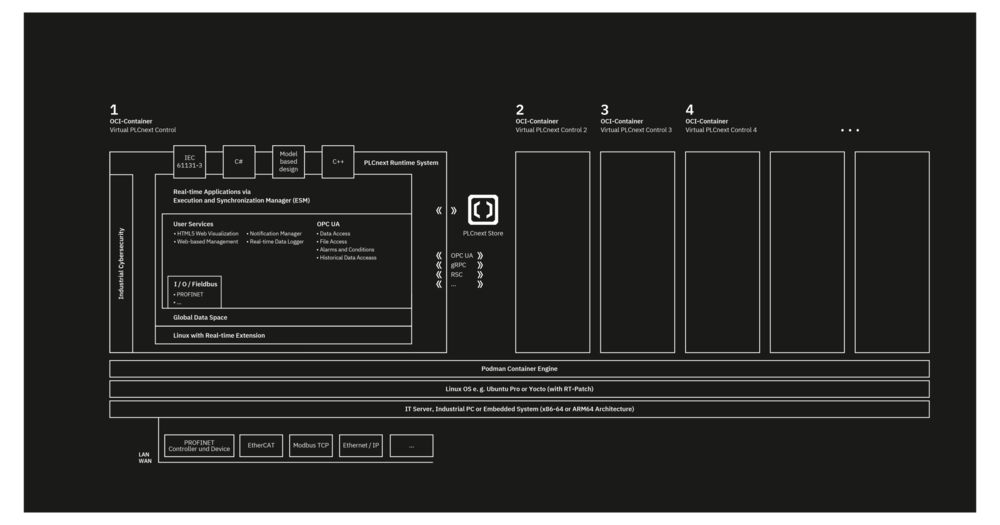
For more detailed information about the software architecure please check this website.
Merging control logic with modern software
The real added value emerges when conventional control logic is combined with modern software components, for example by integrating high-level languages without sacrificing real-time capability.
This is exactly where Virtual PLCnext Control from Phoenix Contact comes in: It combines the deterministic world of PLCs with the flexibility of modern software development. This is made possible by the PLCnext Runtime, which runs both on virtual controllers and on hardware-based PLCs from Phoenix Contact.
This combination enables:
- Use of high-level languages such as C/C++, C#, or Python
- Use of development tools such as Visual Studio, Eclipse, or MATLAB/Simulink alongside PLCnext Engineer
- Easy data exchange with other applications, systems, and containers
- Use of technologies and tools such as Docker, Podman, or Node-RED
Companies benefit because IT and OT developers can collaborate more closely. Silos are broken down, allowing new solutions to be implemented faster. A key aspect of modern vPLC solutions is the simultaneous use of conventional IEC 61131-3 languages and high-level languages. This combination offers decisive advantages: Developers can work in their preferred programming language, while complex tasks can be implemented in the language that handles them most efficiently. For example, control functions can be implemented in IEC languages or MATLAB/Simulink, while data-intensive applications run in parallel in Python or C++.
This interdisciplinary collaboration enables OT and IT experts to work on a shared platform.
Deterministic execution through intelligent task handling
A critical factor in automation is the deterministic processing of control tasks. Virtual PLCnext Control ensures this through sophisticated task handling.
Different tasks are prioritized and precisely scheduled:
- Cyclic tasks for time-critical processes
- Event-driven tasks for flexible responses
- Prioritization to ensure real-time capability
It makes no difference whether a program was developed in IEC code with PLCnext Engineer, in C++ with Visual Studio, or in MATLAB/Simulink. Programs from all these toolchains are executed deterministically through task handling. These mechanisms keep the controller reliable and precise even in virtualized environments, which is essential for industrial applications.

