

Engineering Software for PLCnext devices


)
PLCnext Engineer
Speed up your application process
PLCnext Engineer is the engineering tool for your PLCnext project. By combining configuration, programming, visualization, diagnostics, and safety engineering in one software package, it supports the entire engineering workflow in a single environment.Integrated AI capabilities provide context-aware engineering support, helping users create applications faster, understand existing projects, generate code, and simplify documentation tasks directly within the engineering environment.
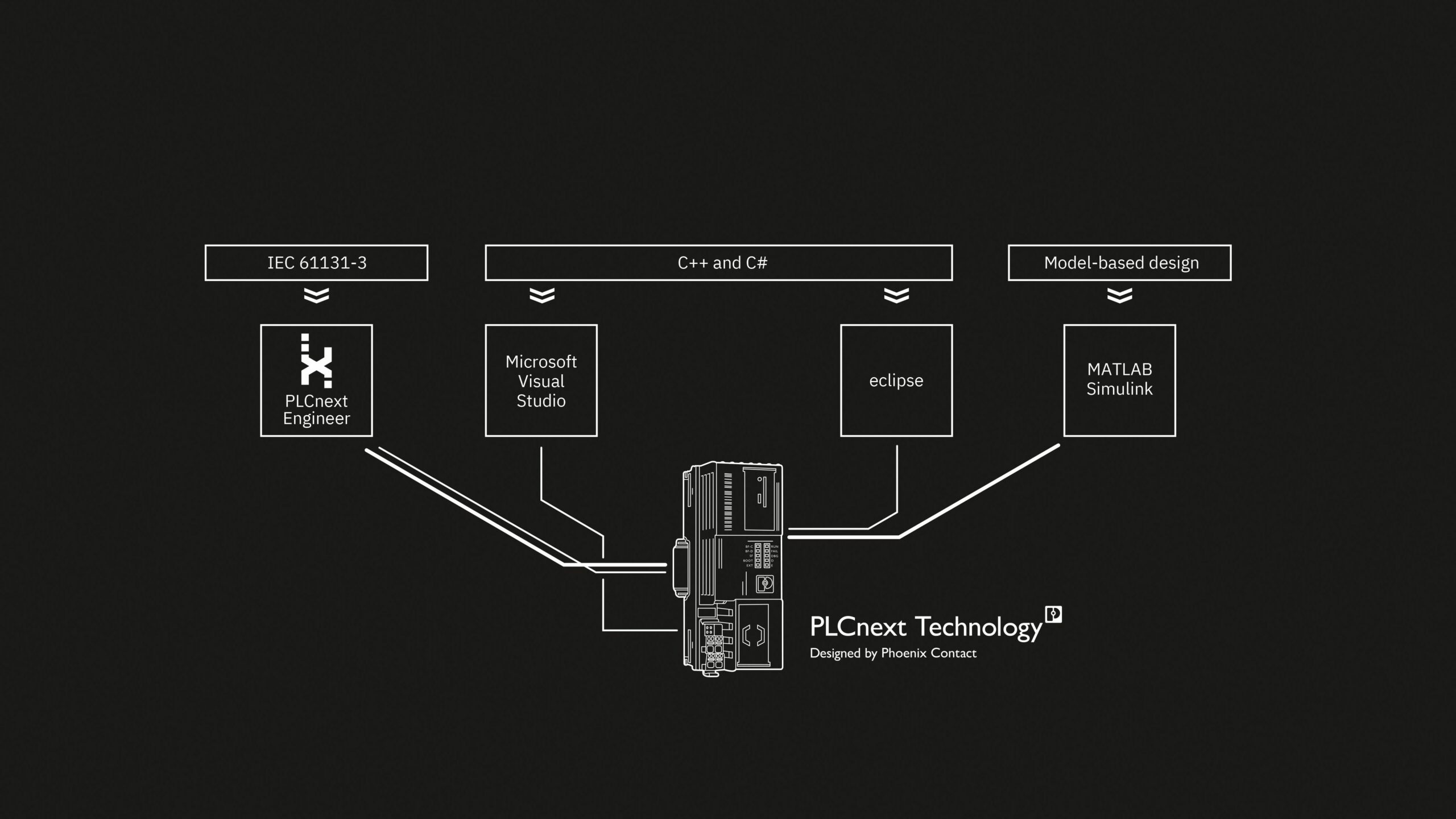
For graphical programming languages, you can choose between network-oriented or free graphical programming, and mix the different languages within program organization units. With PLCnext Engineer you can easily configure your networks, integrate high level language programs or MATLAB® Simulink® models and commission and manage them on a PLCnext Control.
Your benefits
Flexible expansions for full individuality
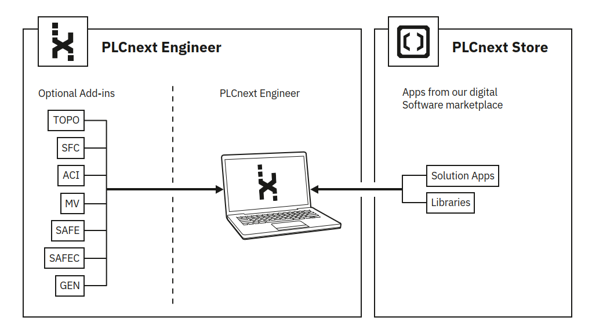
Extend PLCnext Engineer beyond basic engineering. Enhance the free version with powerful add-ins such as safety engineering, MATLAB®/Simulink® integration, visualization tools, and AI-assisted engineering.Accelerate your application by using ready-made solutions and software modules from the PLCnext Store.
Focus on Innovation
AI-assisted engineering
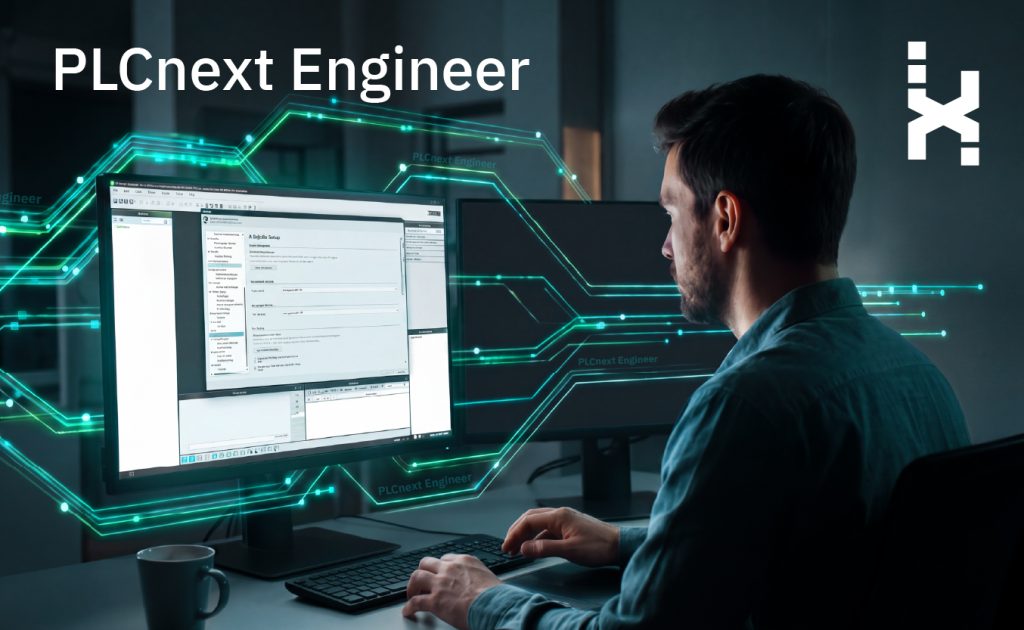
PLCnext Engineer is evolving beyond traditional engineering tools by integrating AI directly into the development workflow. Based on project data, source code, and engineering context, the AI assistant can support tasks such as IEC 61131-3 code generation, project exploration, application understanding, and documentation creation. This helps engineers reduce repetitive work and focus on solving automation challenges.FAQ: AI in PLCnext Engineer
What is the PLCnext Engineer AI Assistant?
The PLCnext Engineer AI Assistant supports developers with typical engineering tasks such as project analysis, device configuration, code analysis, code optimization, and the creation of documentation directly within PLCnext Engineer.
Can the AI explain existing projects?
Yes. The AI Assistant analyzes the project structure and source code and can summarize functions, interdependencies, and processes in an easy-to-understand way.
What are the benefits of AI in engineering?
The AI Assistant helps make knowledge available more quickly, reduce routine tasks, identify errors at an early stage, and shorten development times.
Can the AI generate code?
The AI Assistant supports the creation of program structures, variables, and code suggestions based on natural-language input.
Can the AI review my code?
Yes. The AI Assistant analyzes existing code and identifies potential risks or opportunities for optimization.
Which AI model is used?
The architecture supports various large language models (LLMs). Customers can decide which model they want to use.
Is the AI Assistant already available?
The AI Assistant is available with PLCnext Engineer version 2027.0.
Who controls my project data?
The customer decides which data and contextual information are made available to the AI Assistant.
Seamless integration
Convenient configuration
PLCnext Engineer simplifies the integration of modern automation technologies into a single engineering workflow. Easily configure networks, connect high-level language applications, and deploy MATLAB®/Simulink® models directly on PLCnext Control devices. Standard automation and high-level language programs can be seamlessly linked through shared data lists, enabling efficient data exchange between physical I/O, control applications, and software components.This unified approach significantly reduces engineering effort and simplifies the commissioning, operation, and maintenance of complex automation systems, even in applications with little or no IEC 61131-3 programming.
Connect your automation world
PLCnext Engineer makes it easy to integrate different devices, systems, and networks into your automation project. A wide range of industrial communication protocols supports flexible connectivity, including PROFINET, EtherNet/IP, EtherCAT, Modbus, OPC UA, and IO-Link. Communication can also be extended for specific applications, for example with remote-control and energy protocols such as IEC 61850, IEC 60870-5-101/-104, and DNP3.
