

Industrial automation is evolving. While traditional programmable logic controllers (PLCs) have been at the heart of machines and systems for decades, virtual PLC solutions are becoming increasingly important. Both technologies share the same goal: reliable control of industrial processes. Rather than competing with traditional PLCs, virtualization can be seen as an extension of them. A virtual PLC (vPLC) can run independently of dedicated controller hardware, without disadvantages compared to a hardware-based PLC.
A traditional PLC is a purpose-built hardware device designed for industrial use. It is often installed in a control cabinet and offers a high degree of ruggedness, local bus interfaces, or real-time capabilities.
A virtual PLC is a software-based controller that runs on hardware such as industrial PCs, edge devices, or servers, or in virtualized environments. This decouples the runtime system from the hardware, allowing it to run flexibly on different platforms. As a result, multiple controllers can run on a single system (multiple instances), resources can be scaled as needed, and additional software can run in parallel on the same system.
A virtual controller still provides all the functions and configuration options offered by a traditional PLC.
Phoenix Contact offers its customers both approaches within the PLCnext ecosystem. The AXC product family (including the AXC 1252, AXC 2152, and AXC 3152) is available for traditional hardware-based control. These controllers have been specifically developed for industrial environments and provide direct connectivity to field devices, I/O systems, and communication networks.
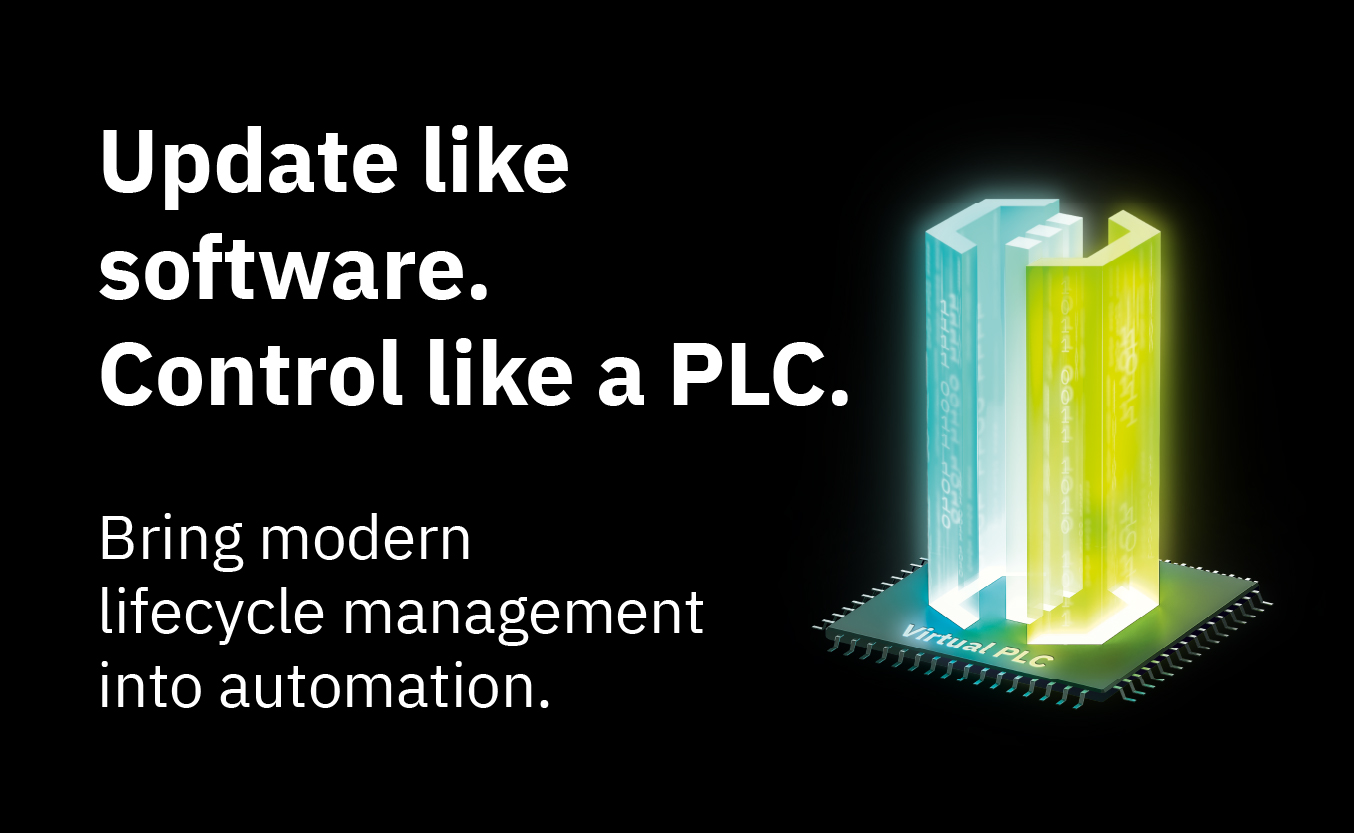
In parallel, Phoenix Contact offers Virtual PLCnext Control as a fully virtual control solution. The controller can run as an OCI container on various hardware systems with a Linux operating system and the Potman container engine.
The key advantage: The project engineering workflow remains unchanged, with development carried out using PLCnext Engineer, among other tools. This allows existing engineering expertise, software libraries, and applications to be used on both hardware-based and virtual platforms.
Conclusion:
Virtual PLC solutions add a high degree of flexibility, scalability, and IT integration to industrial automation, while traditional PLC systems continue to have their place. For each individual project, the choice of system architecture requires a decision on whether an on-site hardware-based PLC system is needed or whether virtual controllers offer advantages. Incidentally, hybrid systems combining both approaches can also be a solution!
Virtual PLC solutions add a high degree of flexibility, scalability, and IT integration to industrial automation, while traditional PLC systems continue to have their place. For each individual project, the choice of system architecture requires a decision on whether an on-site hardware-based PLC system is needed or whether virtual controllers offer advantages. Incidentally, hybrid systems combining both approaches can also be a solution!
You want to learn more about our Virtual PLCnext Control? Just check out the webinar.

