




Energy data can make its way into energy management software in different ways. Some companies rely on local processing where all data remains within their own network. Others use the cloud to centrally evaluate multiple sites or reduce IT effort. Both approaches work with the same measurement and device technology. The only difference lies in where the data is processed and visualized.
Whether the data comes directly from a measuring device, is aggregated via an edge device or enriched with additional information by a PLCnext Control, each of these paths can converge either locally or in the cloud. This creates an energy management system that adapts flexibly to the existing infrastructure, not the other way around.
Fully Local Energy Management
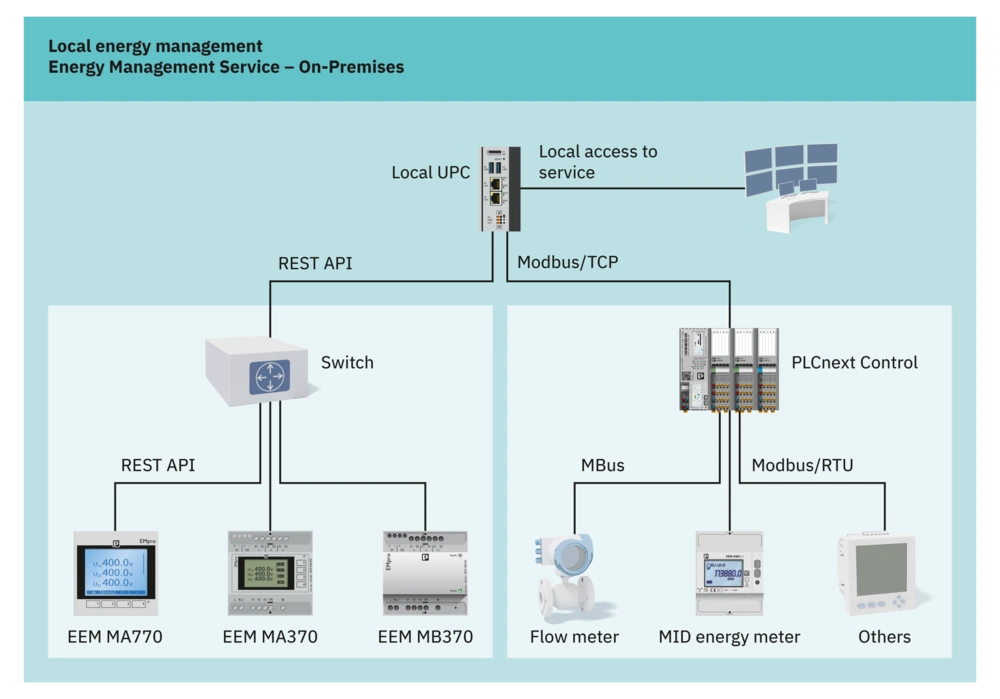
Many companies want to process energy data exclusively within their own network, whether for IT security reasons, due to isolated production environments or because no internet connection is available. In this scenario the entire data flow remains local.
Data flow:
Measurement
Energy is captured using Rogowski coils, current transformers or direct measurement.
Energy meters
Energy meters, like the EMpro or MID meters calculate the energy data and make it available locally on the network, for example via Modbus/TCP, REST API or CSV exports.
Edge device
If multiple measurement points are present or data needs to be standardized, an edge device collects the values, normalizes them and makes them available locally.
Energy Management Service – On Premises
The energy management software runs on the edge device. It directly receives the data, stores it internally and visualizes it on local dashboards.
Typical use cases:
- In isolated production networks
- With strict IT security requirements
- When data must not leave the facility
- When a stable internet independent solution is required
Advantage:
An energy management system can be implemented completely locally, without internet access and without external dependencies. At the same time all options remain open if a cloud extension is desired later on.
Centralized Cloud Analytics for Multiple Sites
Many companies operate multiple plants, buildings or energy systems that are geographically distributed. A local energy management system at each site would be possible but complex. The cloud-based approach enables centralized cross site analysis without additional servers or local IT infrastructure.
Data flow:
Measurement
Electricity is measured using Rogowski coils, current transformers or direct measurement.
Energy meters
Energy meters, like the EMpro devices calculate energy data and make it available over the network.
Edge device, PLCnext Control or direct cloud connection
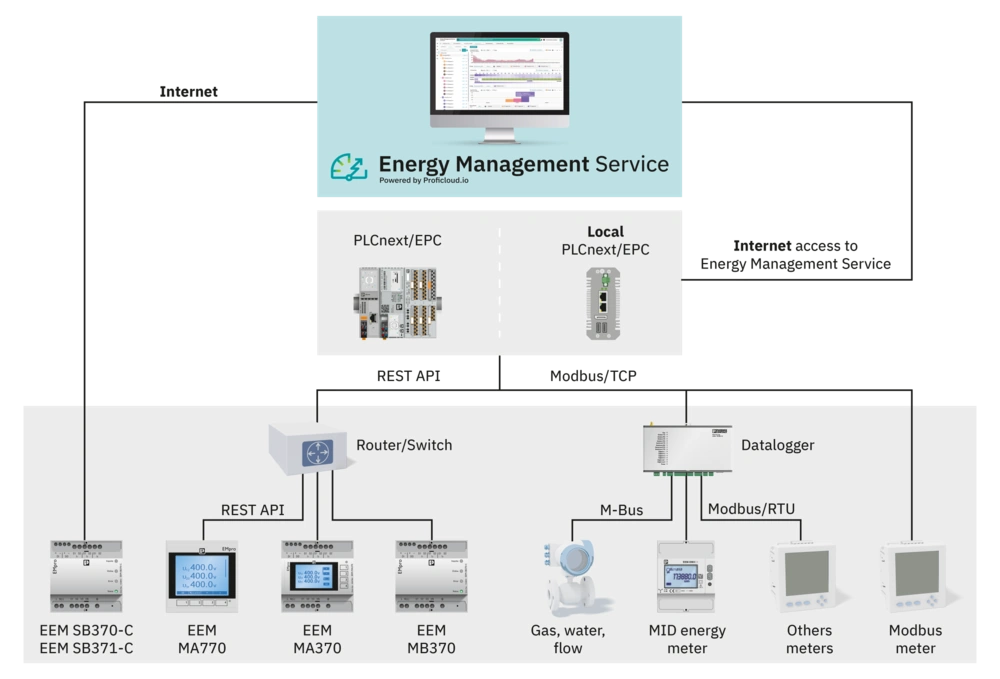
- Modern measuring devices can send energy data directly to the cloud via MQTT or REST API
- Alternatively, an edge device aggregates multiple measurement points and transmits them in bundled form
- A PLCnext Control aggregates the data and enriches it with process data before it is further processed locally or in the cloud
Energy Management Service
Data is stored, visualized and analyzed centrally regardless of which plant or system it comes from.
Typical use cases:
- When multiple sites or buildings need centralized monitoring
- When no local IT infrastructure should be built or maintained
- When dashboards and analytics must be accessible globally
- When updates, scaling and maintenance should be automated
Advantage:
The cloud provides centralized transparency, low IT effort, rapid scalability and cross site comparisons without requiring local storage or server operation.
An Energy Management System That Adapts to Your Infrastructure
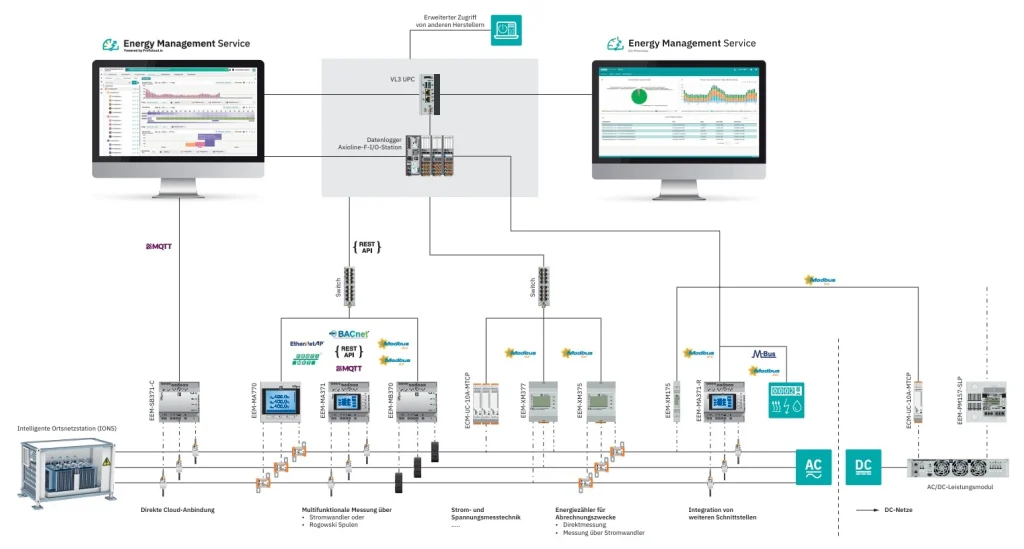
Energy data always originates at the measurement point. However how it is transferred, aggregated or enriched depends on the existing infrastructure. Modern measuring devices can provide data directly. PLCnext Control and edge devices can aggregate multiple measurement points. PLCnext Control can add process information when needed. All of these approaches can converge locally within the network or in the cloud depending on where companies choose to process their data.
This makes it clear that companies can start with what they already have and expand their energy management step by step. Whether operated locally or analyzed centrally in the cloud, both approaches use the same measurement and device technology and can be combined flexibly. The result is an energy management system that adapts to the reality of the installation, not the other way around. Ultimately the specific use case determines whether data remains local or is processed centrally in the cloud.
If you would like to learn more about which solutions best fit your specific use case, you can find further information here: Energy management in practice | Phoenix Contact

